CBRN Masks · Preparedness tools

Nuclear Bomb Simulator

See what a nuclear detonation would do near you: blast, heat and radiation zones, and where the wind would carry the fallout and when it would reach you.

Explore. Understand. Prepare.Free tools for your own location.

Yields above 1 megaton use approximate extrapolations beyond the base reference ranges. These are educational estimates, not validated emergency or safety predictions.

Loading the simulator…

One moment, the map is being prepared.

Educational model, not a forecast. In an emergency, follow official alerts.How it works ↓

How to use it

  1. 1
    Choose a placeSearch a city or postcode, click the map or use your location. With your location on, ground zero is set in the nearest large city and the results show your own exposure.
  2. 2
    Set the weaponPick a yield from 1 kiloton to 1 megaton and choose a surface burst (heavy fallout) or an airburst (wider blast damage).
  3. 3
    Follow the falloutSet the wind. The colored bands show fallout intensity; the box below the map shows when it would arrive at your location and how quickly it decays.

Blast and heat are over in seconds. Fallout is not.

The fireball, the blast wave and the heat flash cause their damage within seconds of the detonation. A surface burst also throws up radioactive dust that the wind carries for tens or hundreds of kilometers and that settles over the following hours.

This fallout is the main danger for people outside the blast zone. It decays quickly, so the first one to two days in a good shelter matter most.

Shielding protects you from the radiation; a tight-fitting gas mask with a particle filter keeps the radioactive dust out of your lungs whenever you have to move outside.

Nuclear bomb blast radius by yield

Distances from ground zero for a surface burst, calculated with the same models as the simulator, for flat ground and clear air.

YieldFireballHeavy blast damage (20 psi)Moderate blast damage (5 psi)3rd-degree burnsLight blast damage (1 psi)Fallout ≥1 Gy/h reaches downwind
15 kt (Hiroshima)0.3 km · 0.2 mi0.5 km · 0.3 mi1.1 km · 0.7 mi1.4 km · 0.9 mi3.5 km · 2.2 mi31 km · 20 mi
100 kt0.6 km · 0.3 mi1.0 km · 0.6 mi2.2 km · 1.3 mi3.2 km · 2.0 mi6.6 km · 4.1 mi74 km · 46 mi
300 kt0.9 km · 0.5 mi1.5 km · 0.9 mi3.1 km · 1.9 mi4.8 km · 3.0 mi9.5 km · 5.9 mi121 km · 75 mi
1 Mt1.4 km · 0.9 mi2.2 km · 1.4 mi4.6 km · 2.9 mi7.4 km · 4.6 mi14 km · 8.9 mi208 km · 129 mi

Fallout distance: reference band of 1 Gy/h (100 rad/h) one hour after the detonation, 50% fission yield, 24 km/h (15 mph) wind. An airburst at a Hiroshima-like height spreads the moderate blast damage about 40% further but leaves almost no local fallout.

Prepare before you need it

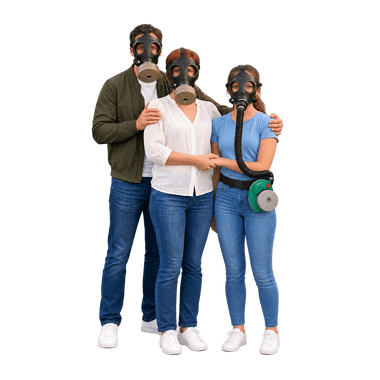
Protection for your whole family

Questions and answers

What does the nuclear bomb simulator show?

It shows the main effects of a single nuclear detonation at any place you choose: fireball, heavy, moderate and light blast damage, prompt radiation, third-degree burns and, for a surface burst, fallout bands carried by the wind. The distances come from standard reference models used for civil-defense planning.

How big is the blast radius of a nuclear bomb?

It depends on the yield and on whether the bomb explodes on the ground or in the air. For a 100-kiloton surface burst, most houses collapse within about 2.2 km (1.3 mi), third-degree burns reach about 3.2 km (2 mi) and windows break out to about 6.6 km (4.1 mi). A 1-megaton surface burst roughly doubles these distances: about 4.6, 7.4 and 14 km (2.9, 4.6 and 8.9 mi). An airburst spreads the moderate blast damage about 40% further but leaves almost no local fallout. The table lists the distances for four common yields.

How accurate are the results?

They are planning estimates for flat ground and clear air. Real effects depend on buildings, terrain, weather and the weapon itself, so use the results to understand the scale, not as a forecast for a real event.

What do the fallout colors mean?

Each band shows the outdoor dose rate scaled to one hour after the detonation, a standard reference value; far from ground zero the fallout arrives later and already weaker. 10 Gy/h: lethal within hours without shelter. 1 Gy/h: life-threatening without good shelter. 100 mGy/h: radiation sickness possible after longer exposure. 10 mGy/h: elevated, shelter to keep the dose low. Seven hours after the detonation the dose rate is only about a tenth of these values.

Can the simulator use today’s weather?

Yes. “Use current local weather” fills in the wind speed and direction for this hour at ground zero from the forecast model of the Norwegian Meteorological Institute (MET Norway). It is a snapshot for orientation, not a forecast for an incident; you can change every setting afterwards.

Does a gas mask protect against nuclear radiation?

A gas mask does not stop gamma radiation; only shielding and distance do that. It does stop radioactive dust and contaminated particles from entering your lungs, where they would keep irradiating you from the inside. That is why respiratory protection matters whenever you have to move through a contaminated area.

How long should I stay sheltered after a nuclear detonation?

US CDC guidance is to get inside, stay inside and stay tuned: at least 24 hours unless the authorities say otherwise. The fallout dose rate falls to about a tenth 7 hours after the detonation and to about a hundredth after 2 days.

Can I share my scenario?

“Share scenario” creates a link with your settings and the chosen point. It contains that place, so only share it with people you trust.

How the model works · assumptions & sources

Blast: peak overpressure from H. L. Brode, Airblast from Nuclear Bursts – Analytic Approximations (1986), for 20 psi (138 kPa), 5 psi (34 kPa) and 1 psi (7 kPa). Airbursts use a Hiroshima-like scaled height of 235 m × W^1/3 (about 580 m at 15 kt). Fireball: maximum radius = 2 × breakaway radius, Glasstone & Dolan, The Effects of Nuclear Weapons (1977), eq. 2.127. Burns: third-degree burn thresholds Q = 5.73 × W^0.081 cal/cm² (DNA report “Flash Burn Casualties from Nuclear Explosions”, 1980), with thermal transmission for about 10–20 km visibility from the 1987 Soviet effects manual as digitised in the open-source GLASSTONE library. Prompt radiation: range of a 500 rem (5 Sv) dose from the same manual. Fallout (surface bursts only): unit-time reference dose-rate contours from Glasstone & Dolan Table 9.93, scaled for fission share and wind speed, with arrival time = distance ÷ wind speed (at least 30 minutes) and decay R(t) = R₁ × t^−1.2. Not included: terrain, buildings, rain-out, wind shear, casualties. Optional current weather: wind speed and direction for the hour at ground zero from MET Norway Locationforecast 2.0 (CC BY 4.0).

Maps: VersaTiles, © OpenStreetMap contributors. Places and postcodes: GeoNames (CC BY 4.0). Reactor data: GeoNuclearData (ODbL 1.0, from IAEA PRIS) and the IAEA research reactor database as compiled by Wikipedia (CC BY-SA 4.0), status updated to October 2026. Current weather on request: MET Norway (CC BY 4.0). Without location permission, the starting area is estimated from the country the store detects and your browser’s time zone. City search runs in your browser; your exact location is used only with your permission and stays in this browser tab. “Use current local weather” sends the coordinates of the scenario point to MET Norway. Map tile requests reveal the viewed map area to the map provider.